Richard Kitschigin
Access: December 2017 / © Thomas GadeFrom the photographic estate of Richard Kitschigin (16 February 1930 – 3 May 2015), we received a collection consisting of approx. 6,000 medium-format (6×6) black-and-white negatives, numerous envelopes with prints, around 1,100 mounted 35mm slides, and 28 CDs containing image files.
It is unclear whether Kitschigin also photographed digitally after the turn of the millennium and what became of those files.

Richard Kitschigin with a twin-lens Rolleiflex (presumably early 1960s)
Richard Kitschigin studied German Studies at the Free University (FU) in Berlin from 1949 to 1953. Afterwards, he remained connected to the FU as a photographer and freelance contributor for the student magazine *Colloquium*. He also offered his photos to other clients. He frequently marked his photos with a copyright stamp, his address, and the note that publication was only permitted with the author’s approval, against receipt and fee.
He found his subjects in the everyday student life of the early post-war period in the western part of the divided city of Berlin, which was still strongly shaped by war damage. Kitschigin photographed trucks piling large amounts of rubble from bombed-out buildings into a debris hill, the so‑called Teufelsberg (120 m) in Berlin’s Grunewald. Many vacant lots were being newly developed, and Kitschigin documented cornerstone-laying ceremonies with prominent figures or photographed the redevelopment of several areas of the Technical University (TU) from the Telefunken high-rise building at Ernst-Reuter-Platz, completed in 1960.
Kitschigin’s fellow students often had to work part-time as so‑called working students. He produced a photo series about a student who lived under primitive conditions in an attic and built new walls in the house.
Student celebrations took place in rooms decorated with hand-painted papers or canvases. The Coca-Cola bottle with a straw was a modern prop.
Kitschigin photographed theatre performances, art, architecture, fashion, musicians, leisure activities, and documented his travels. Numerous excellent portraits of high-ranking personalities from Berlin universities are thanks to him. He was also very interested in motorsports and photographed events around the former Berlin racetrack AVUS.
Although Kitschigin photographed intensively and professionally for many years, his photos are relatively unknown. His biography reveals the reason. On 1 April 1960, Kitschigin was hired as a radio presenter at RIAS (Radio in the American Sector). For professional work, the camera was replaced by the microphone. He quickly took over as head of the Youth and Education Department. In 1987, he became head of the Sports and Leisure Department at RIAS.
Kitschigin was a motorsport enthusiast and from 1970 to 1985 served as the first chairman of the Berlin motorsport club SCUDERIA AVUS. In 1986, he was awarded the Federal Cross of Merit.
RIAS had been founded after the Second World War in the American sector of Berlin. After reunification, RIAS was dissolved. Kitschigin took early retirement in 1991 and continued to devote himself to motorsport as a journalist.
Medium-format black-and-white negatives (6x6)
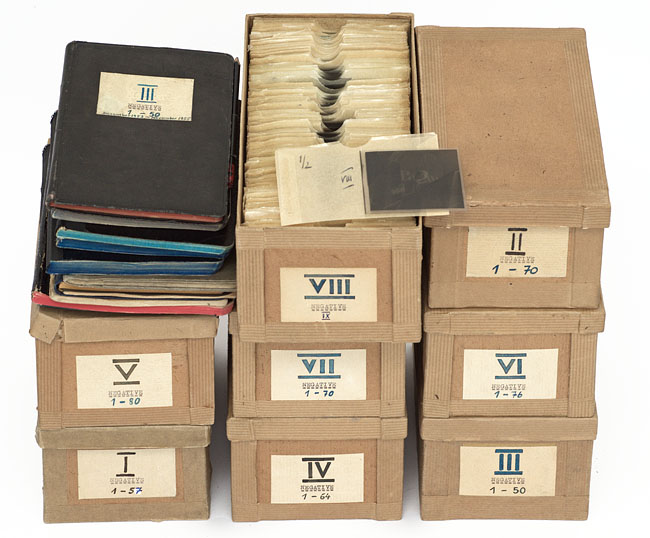
The collection includes 8 boxes full of medium-format (6×6) black-and-white negatives, each stored in individual glassine sleeves with specific information about the image. Content labels such as “1–50” indicate that 50 medium-format films are in one box. Kitschigin kept around 12 shots per film. Altogether, the boxes likely contain around 6,000 negatives.
Detailed notes on the individual photos
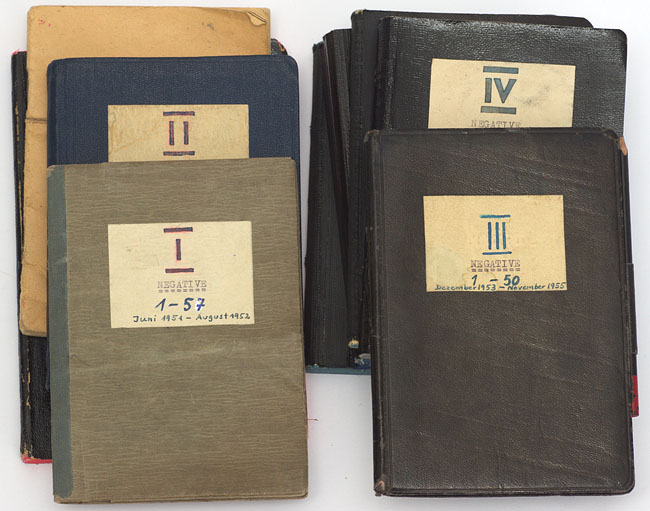

Kitschigin kept notebooks with precise information on the individual photos. The recording date, film, aperture, exposure times, development details, and short captions were recorded. For archivists, such information is extremely valuable and simplifies cataloguing the collection.
28 CD-ROMs with scans
The collection includes 28 CDs with image files. They contain 511 scans in TIFF format (24-bit) of Kitschigin’s photos, totalling 18.7 GB. The scans contain no embedded IPTC information. Thus, no copyright notices or image information are embedded. However, many of these images also exist as prints, on the back of which Richard Kitschigin left his copyright notice with a stamp.
Copying: The data from the 28 CDs fits onto a 25 GB BluRay.
The individual CDs contained handwritten notes stating that the scans were created in 2006 and 2007 by the company LVD, Gesellschaft für Datenverarbeitung mbH, 10178 Berlin, Neue Promenade 6. The scans are relatively high in contrast. Dust and scratches are very well retouched.
All files from the 28 CD-ROMs were first copied to a hard drive and then fit onto a single 25 GB BluRay, which required less space than the stack of CDs. The BluRay contains directories with the same numbering as the CDs. Each directory contains the scans from the CD with the corresponding number.
To preserve the handwritten notes on the CD surfaces, they were photographed and the corresponding JPG files were placed in an additional subdirectory called “Beschriftung CDs”. The CDs were then destroyed.
All files were redundantly burned onto two 25 GB BluRay discs, which are stored in a folder along with notes and correspondence regarding the acquisition of the collection. Additional copies of the TIFF files are stored on external hard drives.
The TIFF files require no further editing. Before integration into the on-site archive, they will be converted to JPG with minimal compression and provided with copyright information.
Photo prints

Numerous prints up to 18×24 cm
Slides
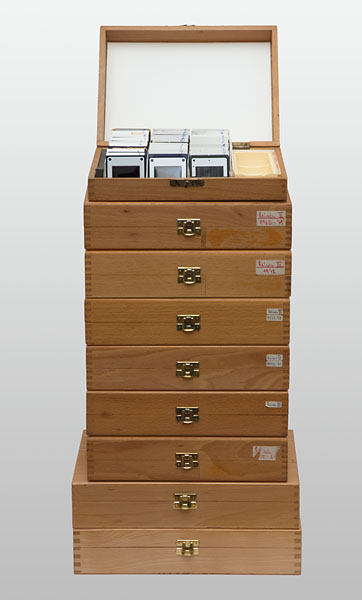
The collection included approx. 1,100 mounted 35mm slides. They were stored in 9 wooden slide boxes that were not completely filled. During a review of these images, around 900 slides were discarded because they showed insignificant everyday domestic scenes that would only be of interest to the people depicted. In terms of quality, these slides gave the impression that they were not necessarily taken by Richard Kitschigin.The remaining slides were re-mounted in thin CS slide frames to store them space-efficiently in just one wooden box without magazine rails. The notes from the individual wooden boxes could be transferred.

Private album – childhood
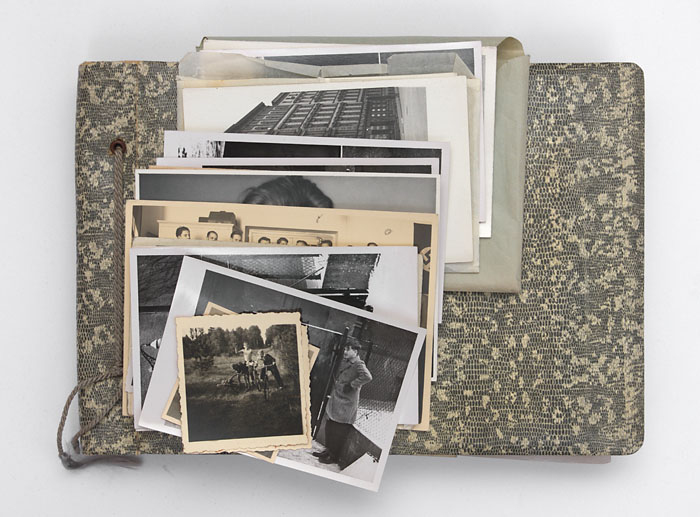
The collection includes a private album as well as some loose family photos.
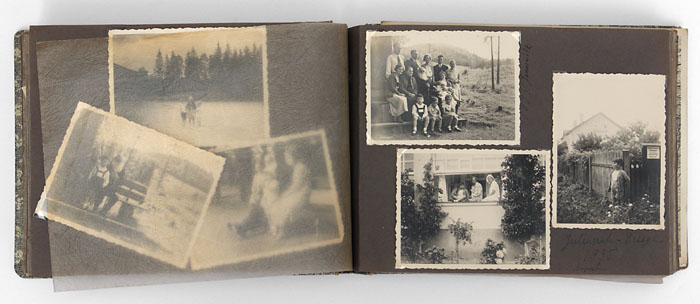
The album contains images from Kitschigin’s early childhood in Breslau, from holidays on the Baltic Sea, and from his university years in Berlin. The period covered is essentially from 1930 to 1951.
Read more: Page 2
The content on this website was originally written in German. Only later were longer articles
translated into English to reach a more global audience. Hopefully, the supporting AI didn’t
introduce too many errors in the process. For pages that primarily showcase images, however,
the additional effort of creating duplicate versions in two languages is hardly worthwhile.