Colorful Microcosm / Franz Baake
2025 © Thomas Gade
Iridescent colors and fascinating forms in everyday products
Franz Baake (1931–2025) was a German filmmaker, photographer, and author. He lived in Berlin and was interested, among other things, in astronomy, psychology, and healing arts. Between the late 1950s and the 1970s, he worked as a director on various films for United Artists. From 2000 to 2010, he photographed numerous common household substances using an analog SLR camera attached to a microscope. He employed polarized light and the microscope’s special illumination techniques to achieve impressive color effects.
Franz Baake passed away in 2025. In the years before his death, he had asked me several times whether I would like to take over his microscope photographs. He assumed that his heirs would not be interested in them. However, no transfer took place during his lifetime. After his death, his children ultimately entrusted the material to me.
Analog photographs through the microscope

The collection consisted of a box full of processing envelopes, several binders containing documents and photographs in plastic sleeves, plus some containers with additional prints and CDs/DVDs. The total weight was approximately 40 kilograms.
It comprised around 100 rolls of 35mm film with up to 36 exposures each. They were stored together with numerous prints (mostly in 13 × 18 cm format) in film-processing envelopes. One roll contains reproductions of images that had already been photographed. The other 99 rolls, however, each show new motifs under the microscope. Baake kept detailed notes, making it possible to trace exactly what was photographed. Most films were fully exposed, resulting in 36 images each. In rare cases, there were also photographs from the domestic environment, such as his kitchen or a bookshelf. The reason for these images is unclear; perhaps they were intended as a basis for white balance in the microphotographs. Due to exposure bracketing, each roll contained only about 5–10 different motifs, amounting to roughly 750 distinct subjects in total. The processing envelopes were stored in a cardboard box about the size of a banana crate and weighed over 18 kilograms altogether.
In addition, there were three large envelopes containing negatives and 20 × 30 cm prints, two containers with further prints in 13 × 18 cm format, as well as smaller prints (9 × 13 and 10 × 15). There were also three A4 binders filled with plastic sleeves containing 20 × 30 cm prints. Another binder held documents from a collaboration with the artist Zsuzsa Szvath, who produced women’s clothing featuring microscope images by Franz Baake, including photographs of models wearing the garments and digital studies. In addition, there were 51 CDs and DVDs.
Cataloguing an analog photographic estate
The microscope images by Franz Baake are a vivid example of an analog collection that can be systematically catalogued and prepared for long-term preservation. The method can also be applied to other holdings.During review and processing, the analog material—including sleeves and older data carriers—is compacted wherever possible in order to reduce volume and weight. Redundant materials and unnecessary containers are removed in the process.
Central to the work is the preservation of the original negatives. These are transferred into transparent polypropylene sleeves. For primary digitization, an Epson Expression 10000 XL (or successor models 11000 XL, 12000 XL, and 13000 XL) with an A3 scan area is used. The sleeves containing the negatives are placed directly on the glass plate and scanned at 2400 DPI. This produces digital contact sheets, modeled on classic darkroom contact prints.
Prints up to 13 × 18 cm can be efficiently processed using a document scanner with an automatic feeder. If the manufacturer’s software is insufficient, VueScan offers a powerful alternative.
The processing envelopes, inserts from CD/DVD cases, and the data carriers themselves are photographically documented using a digital system camera mounted on a repro stand.

A ring binder contained handwritten notes and typed indexes of the motifs—essentially analog metadata. Exposure times are also noted. Note: apertures cannot be adjusted on a microscope.
The sheets from the binder were digitized using a document scanner. The notes are available as a PDF file. It is planned to insert the digitized index prints at the corresponding positions.
Almost too much
When I first became aware of the sheer volume and weight after Franz Baake’s death, I was close to declining. I had traveled there by subway and carried the heavy processing envelopes (18 kg) back in two shopping bags. A few weeks later, Baake’s children brought me a moving box with the remaining items by car. In his apartment there were still additional thick stacks of prints and many framed images. I could not and did not want to take those. Presumably, the loose prints were discarded, and some of the framed images may have been rehung elsewhere.Compressing and creating digital contact sheets
After taking over the material, I pursued two main goals: reducing the volume by reviewing and discarding unnecessary items, and creating digital contact sheets from the negatives.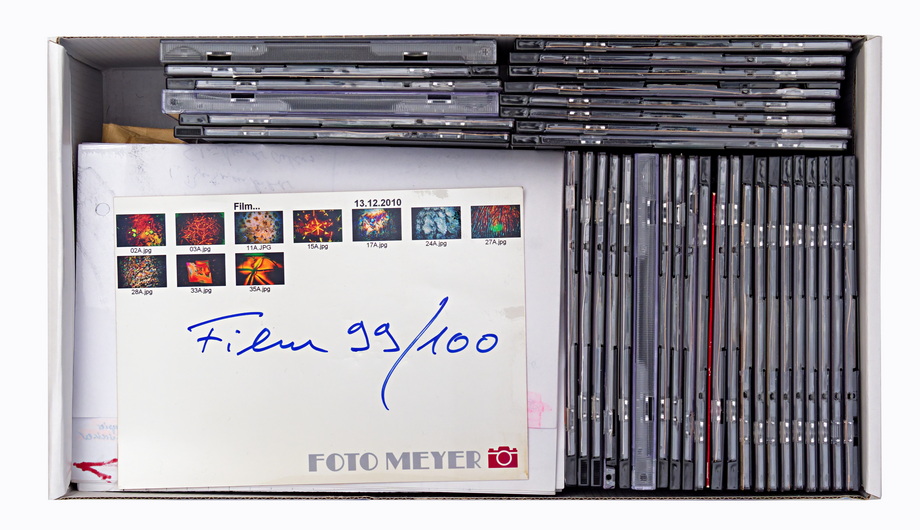
The collection also included 51 CDs/DVDs. They contained not only the microphotographs but also political collages that Baake had created as a follow-up project from around 2014 onward, as well as some processing envelopes with the corresponding negatives.
The data carriers were stored in thin hard plastic cases which, when stacked, formed a pile about 30 cm high. They were copied into a dedicated directory, each into its own subfolder bearing the original name of the data carrier. The cases also contained index prints with handwritten notes and dates, many from 2010 in connection with Szvath’s clothing production. To ensure this information was preserved, I also scanned the inserts and the data carriers themselves. In total, the digitized microscope images amounted to no more than 5.6 GB.
Weight of the data carriers: 51 cases = 2.5 kg, 51 CD/DVDs = 0.79 kg

A processing envelope with index print, negatives, and corresponding prints.
All processing envelopes were scanned to preserve the notes written on them. I then removed the glued-on index prints and scanned them again at 800 dpi.

On the index prints or photographs, the differences within an exposure series are often not visible because color negative film offers a wide latitude for under- and overexposure, and automatic digital image processing equalizes brightness differences when creating prints. As a result, the images within a series are often hardly distinguishable from one another.

All negatives were placed in special polypropylene sleeves and filed in A4 binders. They were then scanned at 2400 dpi using an Epson A3 flatbed scanner. The resulting 48-bit TIFF files had sizes of 3–4 GB with 450–600 million pixels. Such dimensions are unusual but allow an almost full-frame 100% zoom view of individual images on a 4K display. This requires powerful computers with at least 32 GB of RAM and a good graphics card. Since white balance is not automatically adjusted for individual frames when scanning multiple film strips, image processing was required for each image—something hardly feasible on weaker computers. Image management software also reaches its limits with such file sizes. Therefore, after processing, I created additional JPG copies with 8-bit color depth as well as lower-resolution versions to enable quick browsing of the collection.
Only when viewing the negatives or contact sheets (digitally created via flatbed scanner) does it become clear that these are exposure series ranging from dark to bright. Baake himself did not have contact prints. Remarkably, there are hardly any failed shots in the entire body of work. This demonstrates Baake’s deep understanding of optics, lighting, photographic technique, and subject selection.

Thanks to the equalizing image automation used when producing prints from color negatives in the lab, the images within a series appear almost identical. It is usually not possible to tell which was originally exposed more or less. Assignment to a specific negative was only possible when the image number visible on the film edge had been printed on the back of the photograph. Unfortunately, this was done for only a few images. During the review of all prints, many redundant images were therefore discarded.

Rejected! It was sufficient to keep one good example of each, but many prints existed in duplicate or triplicate in almost identical form. What ultimately matters most are the original negatives and optimal scans. Therefore, one print per motif was enough; the others were discarded to improve clarity and save space.

The empty processing envelopes alone (97 pieces) with the original negative sleeves weighed 2.5 kg.

The three binders with 20 × 30 cm prints in plastic sleeves were dismantled. It became apparent that many images in the larger format were less convincing than the 13 × 18 cm prints. Direct prints from the negatives did not have the sharpness of optimized scans. There were also many duplicate and triplicate copies. Here, too, redundant material was discarded. The remaining prints were removed from the sleeves and placed as a stack into a 4.5 cm high archival box.
Tearing up good pictures and throwing them in the trash!
Sorting out unimportant—but also good yet redundant—images is difficult for many archivists in museums. However, excessive restraint often leads in practice to photographic estates not being catalogued at all. That helps no one.The microscope photographs by Franz Baake are a case in point. The stack of discarded prints reached a height of around 50 cm and weighed over 12 kg. Consistently disposing of superfluous material makes it easier to handle the remaining collection and enables more efficient processing with a clear focus on what matters.

After reviewing, sorting, and copying the CDs/DVDs to a shared storage medium, only three ring binders with negatives and Baake’s notes, three boxes with prints, and one folder with documents remain. They weigh approximately 12.5 kilograms. The two cardboard boxes can also be seen in the overall view of the original collection at the bottom left.
Perspective: An additional option for further compaction would be to print the images as indexes on thin, high-quality paper, for example with four to six photos per sheet. This would increase clarity while allowing additional original prints to be discarded, thereby compressing the collection even further.
Document scanner with automatic feeder
The remaining prints from the processing envelopes were digitized using a document scanner with an automatic feeder (Fujitsu fi-6130). This worked surprisingly well; the quality is remarkably high for such a fast process, provided the scan lines are kept clean with a duster (Swiffer) to prevent streaks. The prints were labeled on the back with the respective film numbers and collected in a card file.Digital index with registers, contacts, and notes
After scanning the indexes from the processing envelopes and the notes, and after creating digital contact sheets, the files were compiled into a PDF that provides a very good overview of the work.
The PDF file contains a typed table of contents and all handwritten notes for each film. Handwriting is not always easy to read. This allows anyone to verify whether the typed information matches the notes or the interpretations by Thomas Gade.
Technical challenge of microscope photography
Photographing through microscopes requires precise mechanical and optical alignment so that the image format is fully utilized and sharpness is maintained across the entire frame. Franz Baake created exposure series. Once he found a suitable motif, he photographed it with different exposure times. Today, this process would be easier. Digital photography allows immediate review of results, and there are no ongoing costs for film material and development.Analog costs, then and now
At the time, films were still relatively inexpensive. A 35mm roll cost little more than five euros, especially in inexpensive double or triple packs from drugstores or photo shops. Development including index print and 13 × 18 cm prints cost around 7–10 euros. Added to this were costs for scanning numerous images, usually provided by Foto Meyer in Berlin on CDs or DVDs. Baake also ordered additional prints, which were archived outside the processing envelopes. With around 100 films, the basic costs for material, development, and initial prints likely amounted to between 1,000 and 1,500 euros.If such a project were repeated today (2025) using analog photography, for example with Kodak Gold 200, the cost for 100 films alone would be around 1,000 euros. At Baake’s preferred photo shop, Foto Meyer, film development currently costs €5 plus €0.35 per 13 × 18 cm print. Drugstores offer significantly cheaper options but are slower. Scans would today be ordered directly at a cost of €5–20 per film, depending on provider and resolution.
The additional follow-up costs differ little from those of digital photography.
Several exhibitions
Franz Baake exhibited his works several times in Berlin, for example at Foto Meyer, at the cabaret “Die Wühlmäuse” by Dieter Hallervorden, or in the art space of Terzo Mondo. There are several notices in the press and on the websites of the respective venues.Use and sales
This also resulted in image sales. Franz Baake offered his images to companies whose products he had photographed under the microscope, including Coca-Cola and Dr. Oetker.Evaluation of the microphotographs
A few years ago, we already presented 6x6 slides from the 1960s by Franz Baake, which have a high documentary value. The much later microphotographs must be classified quite differently. They are neither historical documents preserving a slice of contemporary history nor results of scientific research. They show sights in the microcosm, in which everyday substances look entirely different than usual.
Richly colored image. In fact, little more than a simple microscope with a camera adapter is needed for this.
Thus, small white crystals of salt or sugar appear under the microscope with the help of a polarizing filter as richly colored motifs with geometric structures. Everyone knows a glass of red wine, but the tiny, bizarre, and often colorful objects hidden within it escape the naked eye. It is surprising that Baake found completely different structures in different types of wine. Medications, tears, urine, cleaning agents, or old photographic chemicals also provided him with fascinating visual worlds. Plant or animal specimens did not interest him. He focused on materials that were readily available. That this work produced aesthetically convincing results is demonstrated by image sales and the use of his images for the production of women’s clothing.
Baake possessed the necessary expertise to work confidently at the microscope using analog photographic techniques. His work can inspire others to follow his example and discover new visual impressions in materials that surround us every day. It makes no difference whether we photograph analog or digital today—both are possible. Due to the fixed setup of the microscope, modern features such as image stabilization or high light sensitivity are irrelevant anyway.
Analog technology, however, offers a high degree of authenticity compared to the diminishing truthfulness of digital images. This is particularly important for motifs where we might not even notice digital manipulation. At the same time, this report also shows that analog results require far more space than modern storage media, which are also feather-light and can easily be copied losslessly for backup purposes.
The content on this website was originally written in German. Only later were longer articles
translated into English to reach a more global audience. Hopefully, the supporting AI didn’t
introduce too many errors in the process. For pages that primarily showcase images, however,
the additional effort of creating duplicate versions in two languages is hardly worthwhile.