Franz Baake
© Thomas GadeFranz Baake (31 December 1931 – 23 March 2025) was a director, photographer, author, and psychologist. He wrote books and worked as a director from the late 1950s through the 1970s on various films produced by United Artists.
1960 – 1963. Medium-format slides by Franz Baake
Photographs. Approx. 500 photos on medium-format roll film. Mounted 6x6 slides, accession: 2008In 2007 I was asked to get in touch with an elderly gentleman who wanted to sell his photographs. At that time, I was on the verge of giving up collecting photographs by others. Income from licensing such images had almost completely dried up due to upheavals in the image market. The meager returns no longer covered the costs of the labor-intensive cataloguing and archiving. But I was told that he had made good films and published books. That aroused my curiosity, and so I visited Franz Baake.
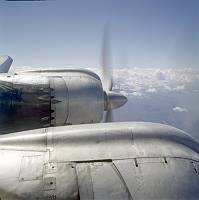
Aircraft 1960
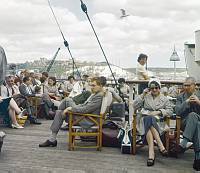
Europe 1960
Mixed collection:
Denmark
England
Netherlands
Denmark
England
Netherlands
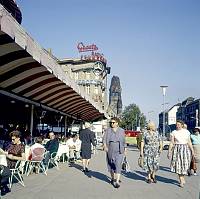
Berlin Kurfürstendamm 1961
Berlin, various locations 1961
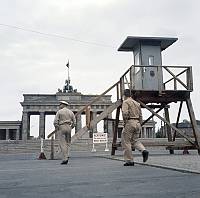
Berlin Wall 1961
New York 1960
Mexico 1960
California 1960
He received me in a central room of his Berlin apartment, where a concert grand piano stood. Various items were spread out on it: chocolates, papers, photographs, books, and other objects. The instrument had been turned into a storage surface. In conversation, Franz Baake proved to be a man of many talents with an extraordinary life story.
Photographic beginnings
At the age of twelve, Franz Baake received the box camera from his mother, which she herself had used in her youth. “Box” referred to simple, rectangular cameras with housings made of wood and cardboard, used with roll film. Baake’s box camera could take eight photographs in the 6 × 9 format per roll. The simple camera, which allowed no adjustment of shutter speed, aperture, or focus distance, was a fair-weather camera that could only be used sensibly in bright sunshine. For Franz Baake, the box camera sparked a passion for photography. However, this happened during the final years of the Second World War, when film gradually became scarce. Photo shops tended to reserve it for customers who also purchased expensive cameras and lenses. Baake obtained a catalog from a photo shop listing the cameras that were still available at the time. However, his parents were not prepared to buy him a better one right away. After the end of the war and the currency devaluation, this was no longer possible anyway.
After several deaths in his family, Baake had to take responsibility for himself at an early age and made a living as a painter’s assistant and in a poultry shop, until in 1952 the opportunity arose for the 21-year-old to complete training as a photographer at the Lette Association, which he finished in 1954 as a journeyman.
United Artists
After that, he worked for United Artists in feature film production as a press officer, cameraman, in editing, and as a director. In 1964 he began studying psychology at the Technical University of Berlin, but continued to work as a director. In 1962 the film Test for the West, on which Baake worked as “Director,” was awarded the Silver Bear at the Berlinale, and in 1974 the film “Battle for Berlin” was nominated for an Academy Award.
In addition, he was a writer. In the late 1960s his book “Poetry, Essays” was published. Among his notable books are “Pia, Pio and Me – The Story of a Single Father” from 1988 and “Jesus Total” from 1992. Franz Baake answered questions about his biography in his book Grandchild Asks Grandfather, published in 2013.
His multi-track career was underscored in 1977 by his admission as a psychologist to the German Society for Behavioral Therapy. He was also interested in astrology and parapsychology. However, it would be completely wrong to conclude from this that Baake was esoteric or out of touch with reality. In 1982 he obtained his master craftsman’s certificate in photography.
At the time of our first meeting, Franz Baake was 77 years old and still professionally active. In cooperation with a medical practice, he had specialized in therapies for patients whom conventional medicine could no longer help. Much of this I learned in interesting conversations before we turned to the slides he wanted to part with.
Color slides in medium format
In eight wooden boxes, roughly the size of shoe boxes, there were mounted 6×6 slides from the period around 1960 to 1961. Each wooden box had a capacity of 100 mounted slides and was not completely filled.
Slide lectures in the USA
The story behind the images: A friend of Franz Baake was studying at Columbia University in New York in the early 1960s. Baake followed his suggestion to visit him and give slide lectures about Berlin in the USA—a promising idea, as the city was in the international spotlight due to tensions between the Western Allies and the Soviet Union. For his photographs he acquired a twin-lens Rolleiflex camera, which allowed 6×6 images on medium-format roll film. He photographed the lively activity on Kurfürstendamm as well as Humboldt University in the eastern part of the city. Other images were also taken around the same time in other European countries.
In his book Grandchild Asks Grandfather, Baake reports that he traveled to the USA in 1960. In 1961 the Berlin Wall was built. There are also 6x6 photographs of this. Whether he traveled back to Germany in between or took the pictures only after his final return is unclear.
The then Governing Mayor Willy Brandt wrote him a greeting for the lectures in the USA. With only 50 Deutsche Marks in his pocket and no knowledge of English, Baake set off and stayed for about a year and a half. He showed his slides frequently. The accompanying text was spoken by an English-speaking friend. He did not earn anything directly from this, but through new contacts he obtained a job as a sound engineer at United Artists, with what was a high rate at the time of 50 dollars per hour. In 1962, one US dollar equaled four Deutsche Marks. Baake did not even have a valid work permit for the USA, but that seemed to bother no one. He eventually returned to Berlin with several thousand dollars.
Baake also photographed in the USA. His New York images look like scenes from feature films of that era: urban canyons, yellow taxis, the skyline in haze, people in hectic everyday life. His images show a good sense for motifs, perspective, and light. Baake used his stay in the USA for a detour to Mexico. Later he also photographed in several European countries.
After more than 40 years, the old slides no longer seemed important to him. Many had developed a reddish color cast. Perhaps that was the reason why contact was made with me. Among other things, I had specialized professionally in scanning old photographs, which often provided the opportunity to digitally remove color casts and restore tonal values in this way.
We agreed that I could freely exploit the images at my own risk and with complete exclusion of any liability for Franz Baake, and could also transfer the rights to third parties. In short: I could do whatever I wanted with them, as long as no risks arose for the photographer. However, his name was always to be credited as the author.
Berlin 1960 to 1961
Around 1960, the Cold War was in full bloom. The Soviet Union stood opposed to the NATO states. The hot conflicts were no longer fought in Europe as proxy wars, but in Korea (1950–1953), Vietnam (1955–1975), and during the Cuban Missile Crisis in 1962 an atomic exchange could have occurred.
After the Second World War, Berlin had been divided into four occupation zones. The eastern half was occupied by the Russians, while West Berlin consisted of the French, British, and American sectors. The western part belonged to the Federal Republic of Germany, while East Berlin became the capital of the GDR. On 13 August 1961, as part of border fortifications between the GDR and the FRG, East Berlin was sealed off from West Berlin by forces of the Soviet Occupation Zone, and construction of the Berlin Wall began as part of the Iron Curtain. This had been quietly prepared and came as a complete surprise to most citizens. Overnight, the border became impassable.
In 1960, Franz Baake photographed Humboldt University on Unter den Linden in the eastern part of the city. Some of his photos show the Brandenburg Gate without a wall. Everyone could still freely cross the sector borders. The following year, this freedom of movement ended, and later photos show walls blocking streets branching off Bernauer Straße, bricked-up windows of houses in the border strip, barbed-wire fences, as well as wreaths and memorials for people who died while attempting to cross the border from East to West.
By around 1960, most of the rubble from buildings destroyed during the war had long been cleared away. But usable bricks were still being salvaged from ruins. One of Baake’s photos shows an old man next to stacked old bricks and scrap metal. In the background rises a rubble hill made from the debris of destroyed buildings. This is probably the 55-meter-high Teufelsberg in Berlin’s Grunewald forest.
In 1961, only a few kilometers away from the Berlin Wall, well-dressed people strolled along the elegant Kurfürstendamm in the Berlin district of Charlottenburg. In the background of some photos, the Kaiser Wilhelm Memorial Church, partially destroyed during the Second World War, can be seen on Breitscheidplatz.
On Kurfürstendamm stands Berlin’s only traffic control pulpit, from which traffic police regulated road traffic from 1956 to 1962. The peculiar building at an underground station consists of a kiosk on the ground floor with a large flat roof, above which a protruding reinforced concrete beam supports the traffic pulpit. The building still exists and continues to be used as a kiosk and as a roof over the stairs to the underground station, while the elevated post for the traffic police has long since lost its function. In one of Franz Baake’s photos, a traffic policeman can still be seen in the pulpit above the kiosk.
Other images from the series show, alongside the pleasant bustle, flowing car traffic with many VW Beetles. Among women, sunglasses and chiffon headscarves were considered fashionable. Franz Baake also photographed people there who evidently had a harder lot in life: an elderly, heavily dressed woman selling newspapers on the steps of a building entrance, or shoe shiners and disabled people who also sold newspapers. In 1963, Baake photographed the crowd in front of Schöneberg Town Hall in West Berlin on the occasion of the visit by U.S. President John F. Kennedy.
2021 – Article in PhotoKlassik
In 2021, I was able to publish some images by Franz Baake with an accompanying text in the magazine PhotoKlassik 2021-IV. On the occasion of the publication, contact with him was renewed. At almost 90 years old, he was mentally sharp and able to remember many things very well, including our encounters concerning my purchase of his old 6x6 slides in 2008. He asked about mutual acquaintances and even about my sister. I had not known before that he knew her.
Status of cataloguing
The slides were quickly removed from their mounts and scanned after acquisition. Most image series could be dated quite accurately based on titles on magazine covers, date references in some images, and identifiable events. The files were provided with embedded image information (IPTC data).
Baake probably photographed handheld. As a result, many images are not quite as sharp as they might have been with the use of a tripod. Tests showed that the detail resolution of the scans from an Epson Perfection Photo V750 flatbed scanner could rarely be improved even with better technology. Some photographs should nevertheless be digitized again in order to achieve better tonal values for particularly color-shifted originals.
Read more: Colorful microcosm under the microscope. Photos by Franz Baake
The content on this website was originally written in German. Only later were longer articles
translated into English to reach a more global audience. Hopefully, the supporting AI didn’t
introduce too many errors in the process. For pages that primarily showcase images, however,
the additional effort of creating duplicate versions in two languages is hardly worthwhile.