Egypt. Cotton. Merchants. Sheet Film Negatives around 1905
Text: Thomas Gade / Acquisition: 2017
1905. Cotton trade in Egypt. Workers unloading a boat
An old junk dealer who had retired dissolved his business in 2017. This was a lengthy process because, over time, he had accumulated many things that were not all saleable. He had to clear out his premises, which took a while for a seasoned junk dealer who, in the process, naturally inspected everything once more to distinguish between trash and items of value.
We knew each other because in 2003 I had purchased a large part of the photographic estate of Hellmut Münzner from him, and we stayed in loose contact. In the aforementioned year 2017, several banana boxes full of dirty cigar boxes containing many slides from that photographer turned up, which were given to me.
In addition, I received two negative albums by other photographers as a free bonus, which at first appeared insignificant. The negatives could not be viewed in the old, yellowed and brittle parchment sleeves. That is probably why they had never found a buyer. I did not expect much from them, because the old fox was a good businessman who had cost me more money than I had ever intended to spend on photographic estates. It was unlike him to give me good negatives free of charge. But he apparently wanted to push ahead quickly with clearing out his storage, so he gave away some things.

Thus I received a small leather-bound album with 100 parchment sleeves. In old Kodak catalogs from the years 1900 to 1905 I found an almost identical example with the designation Eastman’s Negative Albums for 100 negatives 3½ x 4½ for one dollar. Apparently this was then a common storage solution for such negatives.
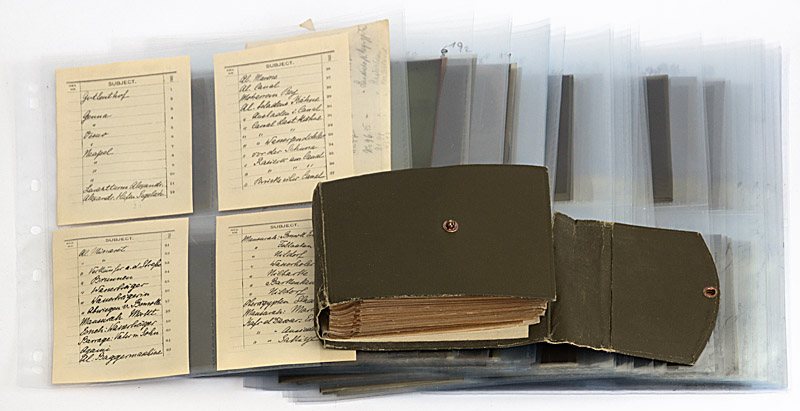
Old slip-in album for negatives. The negatives and handwritten notes were repacked into new sleeves.
Later it turned out that these were souvenir photographs, probably taken in 1904 and 1905. Wool merchants had travelled to Egypt to inspect cotton in the warehouses and to visit business partners. Afterwards they went on to sheep farmers in Australia and New Zealand.
Material
The old black-and-white negatives are roughly playing-card sized and very thin. After being removed from the parchment sleeves, they curled up. This did not happen spontaneously, but took about a minute. This made it difficult to scan these films, as they would not stay flat on the scanner glass. Suitable mounts in which they could have been clamped flat did not exist.Some films were clearly sheet film. Many were irregularly cut. Perhaps the originals did not fit into the parchment sleeves and were therefore trimmed with scissors.
A calm preliminary inspection on a light table was not possible because of their tendency to curl. For scanning the films, a glass pane was placed on top of them to keep them flat. It came from a picture frame and had an anti-reflection coating on one side, which was placed on the glossy side of the films in order to avoid Newton rings.
In almost all of the parchment sleeves there were several films. Sleeves 80–91 were empty. The following ones in part contained more than ten films.
A list with handwritten image descriptions made it easier to identify and catalog the images.
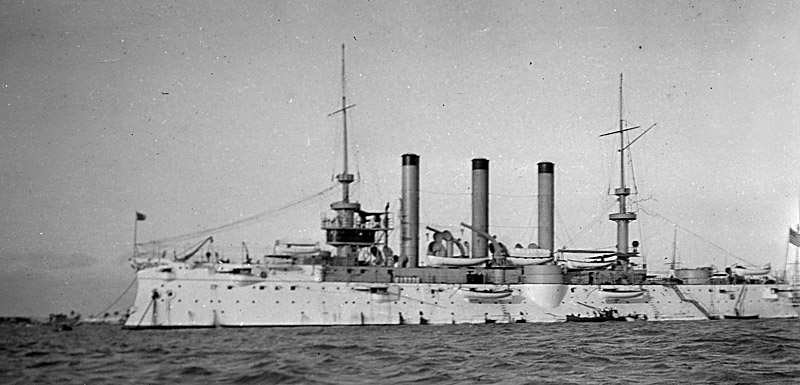
American warship with three funnels
Scanning
The films were scanned with Epson flatbed scanners (Epson Expression 10000XL / Epson Perfection V750 Pro). Both delivered approximately the same quality. The V750 Pro scanned somewhat faster, while the Expression 10000XL had a DIN A3-sized scanning surface and could scan a larger number of images in sequence.Afterwards, the films had such a strong curl that they could no longer be placed back into the original parchment sleeves, which were over 100 years old, without tearing or bending them.
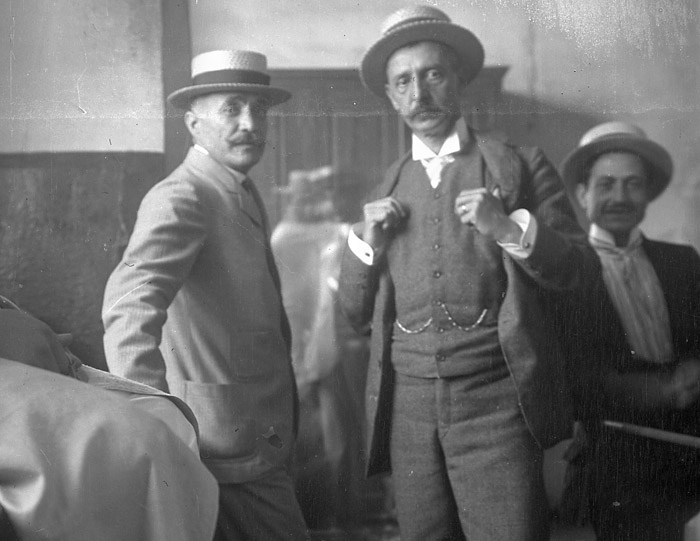
European cotton merchants with straw hats in Egypt

Around 1905. European cotton merchants in Egypt in an office with a telephone
New sleeves
They were therefore placed into conservation-safe polypropylene sleeves with four pockets per sheet. The material of these transparent sleeves is robust enough to keep the negatives flat so that they can be easily viewed on a light table. The repackaging was done immediately after scanning. The films were taken from the original album in sequence, scanned, and placed into the new sleeves.The numbers on the original sleeves were written with a waterproof pen on the edges of all negatives and on the pockets of the new sleeves. Since there were usually several films in each original sleeve, the negatives from such stacks received the same number followed by a hyphen with a consecutive numbering. This also determined the assignment of the file names.
When working through photo lots, I pursue the goal of compressing them. This time that was not possible. A storage solution as space-saving as in the original album was no longer possible with the new sleeves.
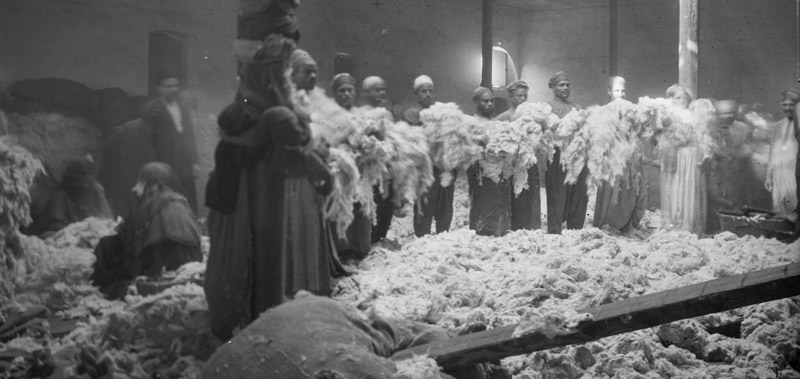
Egyptian cotton workers
Defective camera or misaligned lens standard
The images were probably taken with two cameras, one of which was defective or whose lens standard was incorrectly adjusted. This can be seen in photos that are sharp only on one side, with a gradual loss of sharpness toward the other side.Presumably, a folding camera was used whose lens standard was not aligned parallel to the film plane. Normally, this would have been noticeable when looking at a large ground glass screen. Therefore it is likely that focusing was done using a distance scale and the photographer only noticed the error later.
Motifs
The photos show scenes from a journey from Europe to Egypt, Australia, and New Zealand. Most of the photos are from Egypt. One sees Cairo, the Nile, pyramids, ancient sculptures and buildings. In addition, there are images relating to cotton production and processing, showing Egyptian workers as well as European administrative staff or merchants. Unfortunately, not as many photos were taken in Australia and New Zealand. The photographic material may have run out and, at that time, was not available in distant places for the type of camera used.The passenger steamer Bohemia (commissioned in 1896) of the Austrian Lloyd appears several times.
Total: 225 photos

Egypt around 1905. Cotton. Left: European merchant, right: Egyptian workers with cotton
Topic: Working through a photographic estate. Inheriting photographs. Identifying, scanning and archiving old photos.
The content on this website was originally written in German. Only later were longer articles
translated into English to reach a more global audience. Hopefully, the supporting AI didn’t
introduce too many errors in the process. For pages that primarily showcase images, however,
the additional effort of creating duplicate versions in two languages is hardly worthwhile.